Health and Safety Policy — Commercial Waste Chalfont Saint Giles
 This Health and Safety Policy sets out the commitments and operational standards for our commercial waste and rubbish services. It applies to all team members, contractors and on-site visitors involved with commercial waste collection, commercial rubbish service delivery and site-based waste management across our service area. The aim is to protect people, reduce hazards and ensure lawful, responsible handling of business waste.
Our policy is founded on clear responsibilities, regular risk assessment and ongoing training. We recognise that effective commercial waste operations require coordination between drivers, loaders, depot staff and office personnel. Everyone must understand safe systems of work, the correct use of equipment and the procedures for handling hazardous or contaminated loads.
 Key objectives include the prevention of injury, minimising environmental harm and ensuring compliance with applicable duties. We will maintain safe vehicles and containers, enforce manual handling controls, and use mechanical aids where practicable to reduce reliance on manual lifting during rubbish collection operations.
Roles, Responsibilities and Training
Senior managers will set the health and safety direction and allocate resources. Managers and supervisors are responsible for ensuring that staff receive appropriate training, supervision and personal protective equipment (PPE). Drivers and operatives must follow safe operating procedures, report hazards immediately and participate in refresher training. All employees have a duty to take reasonable care for their own safety and that of others affected by their actions.
 We provide induction training for new recruits, regular competence checks and toolbox talks focused on seasonal hazards, spill response and safe vehicle operation. Training is recorded and reviewed to make sure it remains relevant to evolving service patterns and the types of waste we collect.
Contractors engaged for bin cleaning, waste transfer or specialist disposal work must provide evidence of their own competence and health and safety arrangements prior to starting work. Subcontracted teams will be monitored to ensure alignment with our standards.
Risk Management and Operational Controls
Risk assessments are performed for all routine tasks and for non-routine or exceptional operations. Controls include route planning to reduce reversing incidents, traffic management at collection points, and segregation of incompatible wastes. Emergency procedures are in place for spill control, fire, and other incidents.
We implement the following control measures where applicable:
- Safe vehicle maintenance schedules and pre-shift checks to prevent mechanical failures;
- PPE such as high-visibility clothing, gloves, eye protection and foot protection for operatives handling heavy or sharp items;
- Manual handling procedures and use of lifting aids to reduce musculoskeletal injuries during rubbish collection;
- Contamination controls to identify hazardous waste and divert it for specialist handling;
- Incident reporting and investigation to learn from near misses and accidents and share improvements.
We monitor near misses and accidents, and use this information to update risk assessments and safe systems of work.
Vehicle, Depot and Site Safety
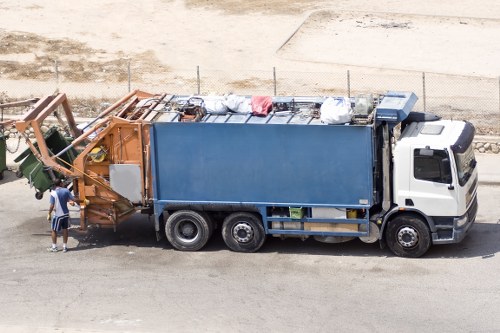
 Vehicles used for commercial waste collections are subject to daily checks, regular servicing and cleanliness standards. Drivers are trained in safe loading procedures and in securing loads to prevent spillages. Depots are organised to avoid unnecessary pedestrian-vehicle interactions and to provide safe walkways and lighting for early starts and late finishes.
Site rules include speed limits, use of designated pedestrian routes and clearly marked loading zones. Lockout procedures are in place for repairs to compaction equipment and other machinery. Waste containers are maintained to prevent sharp edges and structural failure.
We apply precautionary segregation to prevent mixing of hazardous materials, and when in doubt, operatives will quarantine suspect loads for specialist assessment. This minimises health risks and ensures correct downstream disposal.
Monitoring, Review and Continuous Improvement
Performance is monitored through inspections, audits and review of incident data. We set measurable targets for reducing workplace injuries, lost time incidents and environmental releases. Regular safety meetings and management reviews drive continuous improvement, with corrective actions tracked to completion.
Everyone is encouraged to report hazards and suggest improvements. Feedback mechanisms include anonymous reporting and routine safety walk-rounds. Changes to operational practice are accompanied by updated training and refreshed risk assessments.
 This policy will be reviewed at least annually, or more frequently following significant change such as new legislation, the introduction of different waste streams or after a major incident. Reviews will consider changes in service delivery, technology and best practice in the waste and rubbish collection industry.
Legal Compliance and Ethical Commitment
We comply with applicable health, safety and environmental duties relevant to commercial waste operations and rubbish collection services. Compliance is the minimum standard; we aspire to exceed requirements where practical and beneficial to employee and public safety.
All staff are expected to uphold this policy’s principles and to cooperate with investigations and improvement measures. A failure to follow safety procedures may result in disciplinary action, recognising that a safe workplace is a shared responsibility.
Summary of commitments:
- Maintain safe systems for commercial rubbish collection and waste handling;
- Provide training, PPE and supervision for all operational staff;
- Regularly assess and control risks associated with waste management services;
- Investigate incidents, learn from events and improve safety performance.
Final Statement
This policy reflects our commitment to operate safe, reliable commercial waste services across our service area. It is communicated to all employees, displayed at key locations and made available to partners and contractors. Together we will work to ensure that rubbish removal and waste management activities are carried out in a way that protects people, property and the environment.
